Update on engine,
The main reason roller rockers make horsepower over stamped rockers is less friction. To make them work to the utmost you need a few tools and be able to do some extra work. The roller at the rocker tip must contact the valve stem slightly inboard (intake side of the stem) when the valve is closed. Roll out (middle of the stem at half lift) and end up slightly outboard (exhaust side of the stem) when the valve is fully open.
Then if all that wasn't enough, the roller tip (when viewed from the side of the engine looking toward the intake) has to be centered on the valve stem. This is adjusted with the pushrod guide plates. Remember less friction equals horsepower.
With help from the machinist at work we made, a solid hydraulic lifter, and a adjustable pushrod out of a stock 5/16" pushrod. Why buy any tool when it can be made. The solid lifter is used because a hydraulic lifter will colapse when rotating the engine to get your mark on the valve stem top.
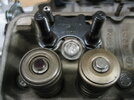
I marked the #1 intake valve stem top with a sharpie pen. After installing the solid lifter ,adj. pushrod and roller rocker on the #1 intake valve, I rotated the engine 2 complete revolutions. Stopping at TDC on the #1 cylinder I removed the rocker and observed that my stock length pushrod was too long. After doing this at 0.050 increments (on different cylinders and both banks),I found that my pushrod length needs to be 0.200 shorter than stock. Total pusrod length shortened (0.175) plus (0.025 preload or lifter spring compression). When you find your length don't forget to add your preload length to it, for your total new pushrod length.
General speaking if the mark on the valve tip is outboard (exhaust manifold side of the head), the pushrod is too long. And if the mark is inboard (intake manifold side of the head), the pushrod is too short.
I ordered up a set of Comp Cam 7.500 magnum pushrods and will post my work when I get them installed.



 .......hey people what's ^^^
 ....
....
 ...
...






 ..., sounds like you got everything going pretty smooth. Still really don't know alot of what you are speaking of....


