• We have upgraded our forum software! See here for details.

Adjustment of the ignition of 235 engine

Setting Ignition Timing To Full Advance

OK, will try to understand what you mean:
I have to adjust 28°-33° with 3000 RPM? and what happens with 600 RPM? My mechanic looked to me very critical because he knews the adjustment only with idling.

rough is relativ but runs like silk is far away at the moment: i felt more power with 28° BTDC as my first adjustment with 10°ATDC.

And the next thing if i go with the pedal to the metal i can hear the pings from my valves, i think so. Therefore i thought my ignition point is to late or could it be thats the carby adjustment is not exact? I tooked my old carb from the 216 with intake/exhaust and put it on the 235 and gave him more mixture. Is it possible or have to use a new carby?

I just bet your Mechanic gave you a funny look ~ this is one of those things you only learn if you're a really nosy student who asks questions and pays close attention ~ look at it this way : racing engines are always tuned at full power RPM's , right ? it only makes sense , it runs more efficiently , cooler and so on .

So ;

@ idle / tickoever of 600 RPM's , the BB lines up as the timing is fully retarded
as you rev. the engine and watch the timing marks , the BB will march out of sight in the little window as the vacuum & mechanical advance mechanisims in the distributor advance the timing .

@ 3,000 RPM's , the engine is wound up to it's happy spot and isn't going to advance any further so you hold it there then twiddle the advance dial on the dynamic timing light until the OT mark (Chevron or Triangle) lines up with the pointer , now look at the dial and whatever it is pointing to , is the total spark advance . hopefully , it'll be between 28° ~ 33° .

If it is pinging , you may try retarding it a degree or two at a time then re-test drive it . one degree is a LOT so don't just mindlessly twsit the distributor to and fro, you'll go mad and it'll never run right .

For it to have audible pink @ 28° BTDC , means you shaved the head or block WAAYY too much or maybe you have domed pistons instead of flat ones .

The CR on these engine is absurdly low so they'll run quite well on 1/2 evaporated fuels that were left there at the end of the last season...

Ping / Spark Knock is unheard of on these engines unless either you raised the CR or maybe an old engine is full of carbon deposits, that's easy to fix .

If it's running roughly , set the timing to the BB @ idle and then check for vacuum leaks , tight valves etc. and once it's sewing machine smooth again (think carburated 1962 Mercedes inLine 6 cylinder) come back and try my timing method , you'll love the extra power and your engine will love it too .

Gotta do everything in the proper order , step by step though . takes time.

I hope this helps ? .
 
I see nothing wrong here Volker ~ these are *very* low pressure , high volume oiling engines ~ that's why they're so sturdy : they can have wildly varying oil pressure and still work hard .

As long as the oil pressure gauge comes up off the peg any time you leave idle / tickover speeds (1,000 MAX.) you're good to go ~ some will have 60 # going down the road , others will only have 15 # @ full tilt boogie and nothing is wrong .

New Melling oil pumps are nororiously bad quality , this is just one more reason I tell folks to make it run before ripping into it ~ if your old , smoking , knocking and piston slapping engine made over 10 # oil pressure at any RPM , the old pump is FINE ! don't take it apart , just clean it up and repair any rips in the intake screen and re-use it .

To test : engine hot and idling , remove the oil filler cap and peer in at the rocker , there's a little hole in the dead center of it ~ rev. the engine to slighty over 1,000 RPM's & wait a minute ~ oil should begin to dribble (not spray) out this hole if all is well .

O.K. ? . did I make any sense this time ? (hope springs eternal)
Hi nate,
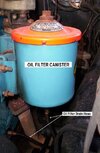
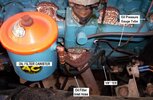
I've been to my garage this time and I opened the oil canister. Its empty! Is there a check valve anywhere that doesn't works? I mount the oil filter container at the inner fender (see on the photo). Its on the level from the valve cover, is this to high?
Wolfgang
 

Attachments

  • Ölfilter.jpg
    Ölfilter.jpg
    135.3 KB · Views: 527
By Pass Oil Filtration

No , that looks fine to me , it is supposed to drain out every time the engine is shut off .

I assume you have a filter element in there else it'll drain out quickly .

The inlet hose goes to the top IIRC . there's plenty of older posts here with good picures of the proper hose connections .
 
@ Nate

Thanks Nate, i've adjusted the ignition with your information and now the truck runs like a devil. I have 26°BTDC and now it sounds very smooth. My next step is to convert the exhaust to a double with Fenton headers and -if Patricks has it- the double carbs on a Fenton intake. Then is finish for this year and time to driving around my area.
 
Last edited:
Well & Good

Be aware the Fentons are for show , not for best running in traffic .

If you decide to use them , be sure to install an exhaust crossover pipe as close to them as you can , it will increase midrange RPM power .

I'd suggest a dual outlet stock exhaust manifold from the guy in TEXAS , cheaper and works better in daily drivers , even with multiple carbys .
 
Wokri man i disagree with you!

If you know your stuf its easy to do it, so i disagree with you about the way you critizise this construction of the ignition. As you are an Volvo intrested guy i can tell you that Volvo there pickup truck also uses the inline six with the same setup from that 50. period. If the system whas a bad one why copy it from GM. Emotions.....emotions dont let them get away with it. By the way what kind a Volvo are you driving anyway? Does it have the same setup as your truck ?

http://www.youtube.com/watch?v=ybNw_3MaFj8

http://www.youtube.com/watch?v=H0bqiUxLMcw&feature=related

Happy ending.


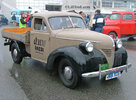
VOLVO PV60-1 IN PRODUCTION 1946-1950

The PV60 was the last of the large six-cylinder passenger cars from Volvo with a traditional side-valve engine. The design of the car was relatively old-fashioned, as the American lines had changed drastically during the war. The car became very popular, primarily because of the comfort it offered. Most of the cars were sold during the late 1940s.

Volvo's first post-war car, the PV60, was also offered in bare chassis form as the PV61. Five hundred of them were produced and transformed into delivery vans or light trucks, except for a handful which received elegant drophead bodies.


TECHNICAL SPECIFICATIONS


Model: PV60-1
Variants: PV 61 Chassis
Produced: 1946 -1950
Volume: 3006
Body: Saloon or chassis intended for special private or commercial bodies.
Engine: In-line, 6-cyl, side valves; 3,670 cc; 84.14x110 mm; 90 bhp at 3,600 rpm.
Transmission: 3-speed with overdrive, steering column gear change.
Brakes:
Dimensions: Wheelbase 2,850 mm.


Misc

http://www.youtube.com/watch?v=Brjl5il3f64


Martinius.

Hi Nate,
be honest, that contructor of this system was a fool or a fan of gambling. On my old VW Beetle and my old Volvo there are only two ways to conect the distributor, the first one is the right on and the second is the wrong one. To install the distributor on this engine is very nervous! I've never need so much experiments and had so often the feeling I've done it wrong and distroy something! I hope I'd never have to change this parts. You needed two people to fix this system, not good!:mad:
Wolfgang
 

Attachments

  • 2006,098 Volvo PV61, 1956_redigerad-1.jpg
    2006,098 Volvo PV61, 1956_redigerad-1.jpg
    192.3 KB · Views: 411
Last edited:
Install the oil canister on the engine intake!

Wolfgang i suggest you could install the canister on the engine intake where it should be! It should drain out as it is on the highest point and no pressure keeps the oil to stay inside.


Hi nate,
I've been to my garage this time and I opened the oil canister. Its empty! Is there a check valve anywhere that doesn't works? I mount the oil filter container at the inner fender (see on the photo). Its on the level from the valve cover, is this to high?
Wolfgang
 

Attachments

  • 51of1.jpg
    51of1.jpg
    27.5 KB · Views: 487
  • 51of2.jpg
    51of2.jpg
    58.1 KB · Views: 416
  • 51of3.jpg
    51of3.jpg
    31 KB · Views: 444
Last edited:
Timing marks 216/235/261

So guys, the BB mark is TDC and the Triangle mark is TDC for the cam?

NO ! .

Pay attemtion ! .

BB is about 7° BTDC

Triangle or Chevron is the TDC point , used for cam , and full advancd ignition setting .
 
Just a thought , Bling bling bling !

Just a thought .They look nice, it sounds nice but thats all. No exstra horsepower there. Messuaring your powerrange it goes down with about 10 % compare to normal effect. And a sideeffect is that water standing in your exhaustpipe system will give rust problems in the long term. But a rustfri steel exhaust system would maybe help you out here, they are offcourse quite expensive but of good quality and nice to look at. I`ll keep my original single exhaust system and let you know how that works when i have installed the dual carbs next spring , that is a promise.


Be aware the Fentons are for show , not for best running in traffic .

If you decide to use them , be sure to install an exhaust crossover pipe as close to them as you can , it will increase midrange RPM power .

I'd suggest a dual outlet stock exhaust manifold from the guy in TEXAS , cheaper and works better in daily drivers , even with multiple carbys .
 
Last edited:
Back
Top